From messy files to retrieval-ready data: why your pipeline needs structured document processing.
You’ve got the vector database spun up, you’re calling the latest LLMs, and you might have even built a complex reranking and evaluation loop. Yet, during user testing, the system’s performance still falls flat: retrieved snippets lack context, tabular data is a garbled mess, and the AI hallucinate answers because the ground truth was malformed. It doesn’t feel like an intelligent agent; it feels like a brittle, keyword-based search engine.
More often than not, the bottleneck isn’t the model. It’s the data layer feeding into the model. In modern engineering, “document parsing” cannot just mean running an open-source script to violently extract strings from unstructured data. For production-grade systems, we need a way to turn complex files into a consumable, chunkable, and citable structured intermediate representation. Today, we’re going to break down why raw text is failing your RAG pipeline, and how the Knowhere API redefines the ingestion flow to fix it.
The Problem: Why “Raw Text” Ingestion Fails
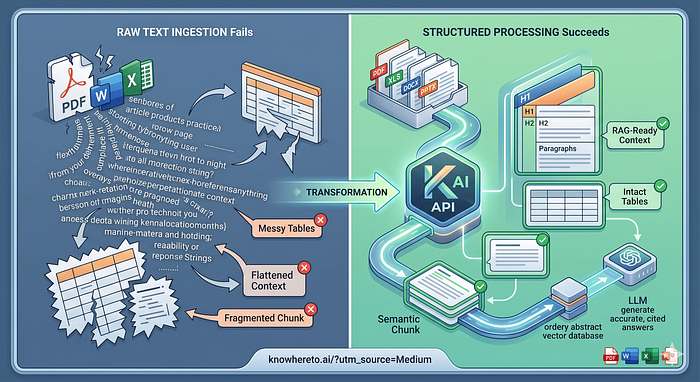
When you flatten documents into raw .txt files, you strip away the contextual metadata that large language models desperately need to understand the material:
- Flattened Headings: The visual and logical hierarchy — how H1s relate to H2s and paragraphs — is completely lost.
- Lossy Tables: Two-dimensional high-density data (like financial tables) gets crushed into a one-dimensional string, destroying the relationship between rows and columns.
- Brittle Chunk Boundaries: Because the layout structure is gone, chunking algorithms are forced to rely on arbitrary character counts. This leads to sentences and logical concepts being sliced right down the middle, introducing massive noise into the retrieval context.
The impact on your RAG system is a negative feedback loop: lost structure → poor chunk boundaries → noisy context windows → degraded citation and generation quality.
The Checklist for Production-Ready Ingestion
If extracting raw text is a dead end, what does a robust ingestion pipeline look like? If you are evaluating a solution, it needs to check these boxes:
- Preserves Structure and Semantic Blocks: The system must recognize sections, chapters, and hierarchy, rather than just returning a wall of text.
- Treats Tables and Images as First-Class Citizens: Tables must not be scrambled, and images shouldn’t be discarded. They need to be retained in a format that downstream multi-modal models or structured databases can actually use.
- Pipeline-Friendly Output: The extracted data must be orchestratable, auditable, and versionable.
- Asynchronous Integration: For real-world production environments dealing with large files, a synchronous “wait-for-response” API will inevitably time out. You need a reliable “upload-process-retrieve” async rhythm.
The 3-Step Playbook: From Files to “Retrieval-Ready” Data
Building a reliable knowledge pipeline across diverse formats (PDFs, Word documents, Excel spreadsheets, and PPTs) requires a three-step shift in how we handle data:
1. Parse for structure, not just text
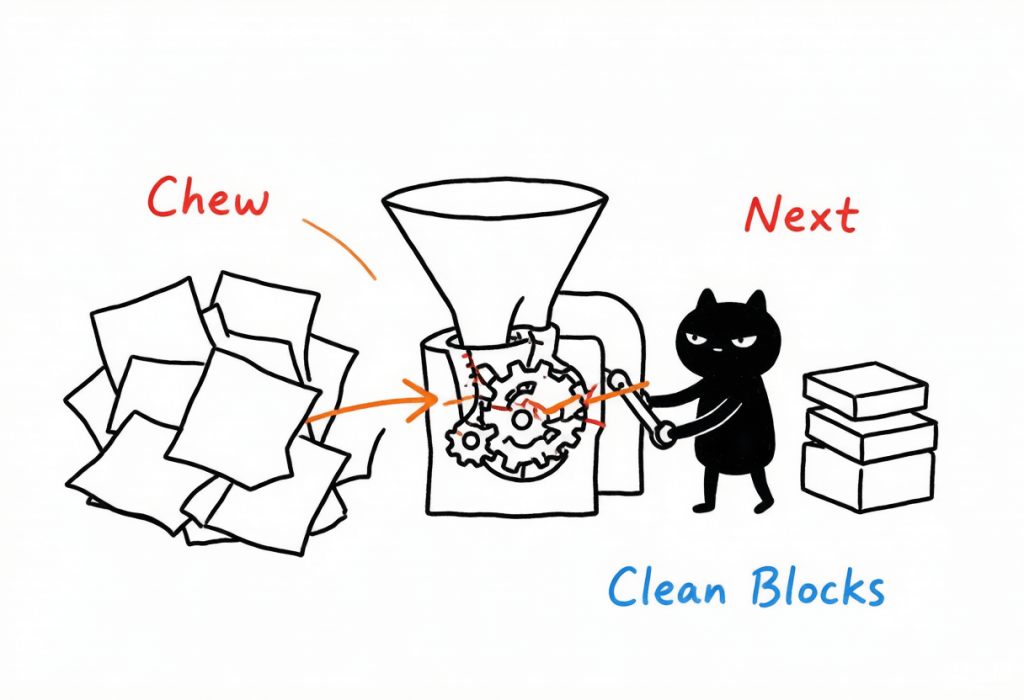
The first step is understanding the “skeleton” of the file. The extractor must perceive the visual and logical layout, converting the content into tagged, structured middleware rather than a flat export.
2. Chunk with boundaries that match how humans read
Once you have structure, semantic chunking becomes possible. Instead of chopping text every 500 tokens, boundaries can be aligned with actual paragraphs, table limits, and section breaks, preserving the complete context just as a human would read it.
3. Package outputs for downstream systems
Finally, the processed data needs to be delivered in a way your database can instantly ingest. This means receiving a packaged output — complete with a manifest, semantic chunks, Markdown, and isolated tables/images — ready to be routed to your vector store.
Knowhere AI: Building the Data Layer for RAG
After seeing engineering teams struggle to build this plumbing from scratch, we realized developers don’t just need another OCR tool; they need a structured document processing layer designed explicitly for downstream RAG systems.
This is exactly what the Knowhere API delivers. We transform messy, unstructured documents into RAG-ready data artifacts.
Here is how the Knowhere API acts as the missing step in your pipeline:
- High-Fidelity Structured Intermediates: Whether it’s an academic paper or a corporate presentation, Knowhere precisely maps the hierarchy, blocks, tables, and images, ensuring they enter your system as structured elements, not text blobs.
- Retrieval-Optimized Chunking: By leveraging our pre-processed chunks and accompanying artifacts, you can fetch data based on true semantic boundaries, drastically reducing the “garbage in, garbage out” problem in your vector search.
- Designed for Real-World Pipelines: Knowhere delivers standardized ZIP result packages alongside Manifest files. This allows for seamless integration into your automated CI/CD and data quality assurance workflows.
- Developer-First Async Flow: We know how engineering teams operate. With our async task model and SDK, you can quickly build the complete loop:
Create Task -> Upload -> Poll -> Download Deliverables, without worrying about underlying concurrency issues.
Who Should Invest in This?
If your engineering team is building enterprise RAG, internal knowledge bases, or document Q&A systems — especially if you are handling a messy mix of PDFs, Word files, Excel sheets, and PPTs — refactoring the data layer before it hits your model will yield the highest ROI for your pipeline’s accuracy and traceability.
Here’s what that looks like in practice: Instead of dealing with complex concurrency and webhooks, your engineering team can run the entire upload -> poll -> download loop with just a few lines of Python using our SDK:
from knowhere import KnowhereClient
client = KnowhereClient(api_key="YOUR_API_KEY")
task = client.tasks.create(
file_path="complex_report.pdf",
extract_tables=True,
extract_images=True
)
print(f"Task created: {task.id}. Processing…")
completed_task = client.tasks.wait_for_completion(task.id)
if completed_task.status == "SUCCESS":
client.tasks.download_result(task.id, output_dir="./rag_ingestion_data/")
print("Downloaded: manifest.json, semantic_chunks.json, and parsed elements.")
Next Steps
Stop patching retrieval logic to compensate for terrible raw text data. Your AI is only as smart as the structure of the data you feed it.
You can grab your API Key and run your first structured parsing task with Knowhere API today. Try running a file through our SDK, download the ZIP package, and see what data actually designed for RAG looks like.
Originally published on Medium.
 Blog
Blog 