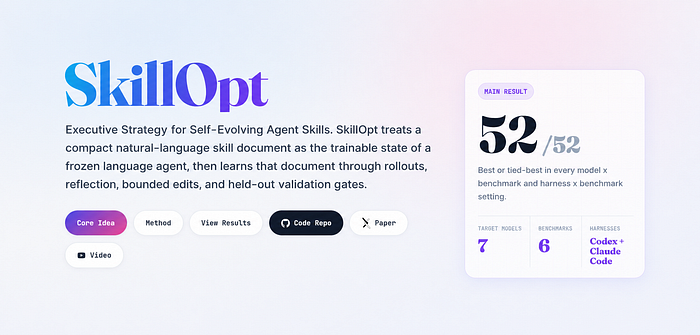
In current Large Language Model (LLM) application development, building an agent capable of stably executing specific tasks has always presented an engineering dilemma.
The Engineering Dilemma
Path 1: Manual Prompt Engineering. This approach is highly dependent on manual prompt writing. While intuitive to start, it relies heavily on the developer’s personal experience. As business scenarios grow more complex, manual debugging often leads to a whack-a-mole situation: adding an instruction to patch a vulnerability here might trigger model hallucinations in an unexpected place over there.
Path 2: Model Fine-Tuning. Developers who have fine-tuned large models know this pain well: trying to make a 10-billion-parameter model understand a specific task immediately introduces severe VRAM bottlenecks and exorbitant compute costs. Even with parameter-efficient techniques like LoRA, the underlying engineering complexity and data preparation costs remain stubbornly high. The most intractable issue is the iteration process itself: once the base model undergoes a generational upgrade, those hard-won fine-tuned weights rarely transfer over, forcing you to scrap the entire engineering pipeline and start from scratch.
Faced with this tug-of-war between compute power and manual labor, the SkillOpt (Executive Strategy for Self-Evolving Agent Skills) framework recently proposed by Microsoft Research offers a brand-new engineering perspective to break the deadlock.
The Core Idea: Text-Space Optimization
The core philosophy of this paper is quite straightforward: it abandons direct modification of the underlying neural network weights entirely. Instead, it treats the AI agent’s skill.md document as “trainable parameters,” much like in deep learning. By building an automated textual feedback and updating mechanism, SkillOpt enables the agent’s capabilities to self-evolve, all while keeping the target LLM in a completely “frozen” state.
To truly grasp SkillOpt’s mechanics and the technological impact it brings, we can run a deep thought experiment comparing it to classic machine learning training workflows. This is arguably the most inspiring part of the framework: essentially, it replicates the deep learning process of finding “gradients,” but entirely within a purely textual semantic space.
In traditional gradient descent, a model generates predictions via forward propagation; upon detecting an error, the system calculates the loss function and computes the gradient via backpropagation. This “gradient” acts as a precise compass, telling each abstract numerical parameter which direction to adjust to reduce the error rate. SkillOpt’s brilliant innovation is taking this deeply low-level mathematical logic and elegantly mapping it onto the semantic space of natural language.
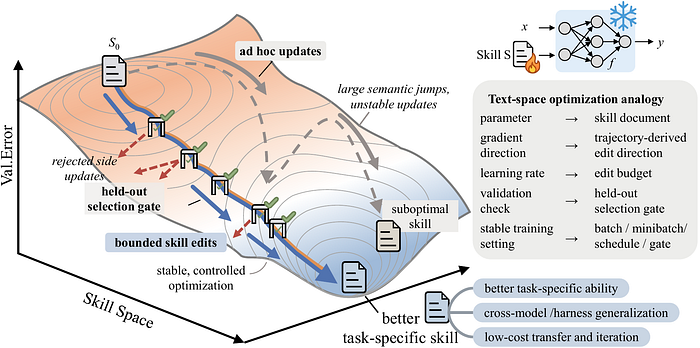
Figure 1: An analogy of SkillOpt’s text-space optimization. The right side demonstrates the perfect mapping from traditional parameter optimization to “textual skill optimization”. The blue line on the left represents the stable optimization path achieved via “bounded edits” and “validation gates,” effectively avoiding the semantic jumps and system crashes shown by the dashed lines.
The Optimization Cycle: Rollouts and Textual Gradients
During this semantic optimization cycle, the system first assigns a large language model to act as the “executor”. It takes the initial skill.md and attempts to process a batch of complex, real-world tasks. This step is termed the Rollout in the framework, conceptually identical to forward propagation in mathematical models. All the interaction logs, successful experiences, and failed attempts left by the executor are thoroughly recorded, forming data akin to “experience replay” in neural network training.
Subsequently, the true “semantic space optimization” begins. The system introduces another LLM that doesn’t execute tasks directly but acts strictly as the “optimizer”. Like a senior human architect conducting a Code Review, its job is to meticulously scrutinize the generated execution trajectories. When the optimizer catches the executor hallucinating, it doesn’t just slap a “failed” label on the task; it analyzes the root cause of the misjudgment — was a rule in skill.md too vaguely defined, or was there a missing instruction for a specific edge case?
This highly precise natural language diagnosis is the “Textual Gradient” extracted by SkillOpt.
It is no longer a tensor matrix filled with positive/negative signs and floating-point numbers; it is a simple sentence. Yet, just like a mathematical gradient, this natural language sentence points with extreme precision to the exact paragraph in skill.md that needs modification, dictating the sole direction needed to drive down the system’s error rate. Based on this “text-level” gradient feedback, the optimizer proposes edits to the current skill.md, completing a full closed loop from “error feedback” to “policy update”.
Taming Uncertainty: Bounded Edits and Validation Gates
However, we must acknowledge that editing natural language carries massive uncertainty. If the optimizer were allowed to rewrite skill.md limitlessly in the direction of the textual gradient, it could easily trigger a logical collapse of the semantic space, invalidating previously functioning instruction structures and leading to a catastrophic regression in capabilities. To tame this risk, SkillOpt introduces two critical defense mechanisms.
- Bounded Edits Mechanism
Understanding this concept reveals how the system controls textual evolution. This is the equivalent of an LLM controlling the Learning Rate during deep learning. The framework imposes hyper-strict limits on the number of text lines permitted to be revised during a single optimization step. This heavily clipped edit budget forces the model to perform local optimization via small, iterative steps. Full-scale refactoring is strictly forbidden, guaranteeing absolute stability in the core skill document’s evolution.
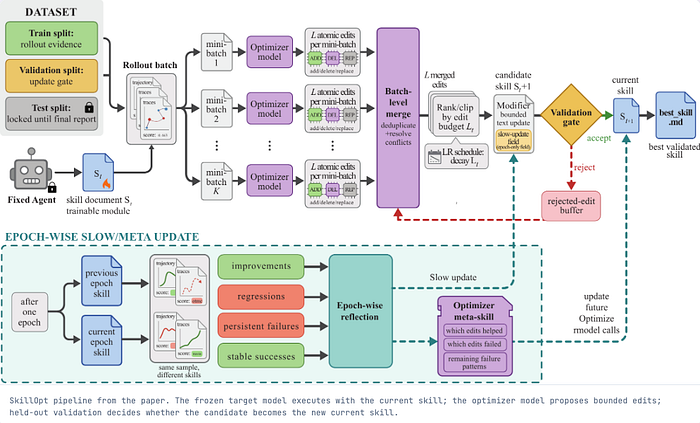
Figure 2: The batch processing workflow for Bounded Edits. The optimizer generates atomic-level editing instructions (“ADD, DEL, REP”), which are then merged and strictly clipped according to the Edit Budget, ensuring that a single modification will not lead to a collapse in capabilities.
2. Validation Gate Mechanism
Secondly, to utterly eliminate any form of “negative optimization,” SkillOpt incorporates a rigorous Validation Gate mechanism at the tail end of the pipeline. Any new version of skill.md generated via bounded edits cannot go live immediately. Instead, it must be pushed to a held-out test set — completely independent of the training data — for verification. An edit is officially merged into the main branch only if the new document’s actual runtime score strictly exceeds that of the older, historical version. This tightly controlled, greedy-algorithm-esque strategy fundamentally guarantees that the agent’s system capabilities monotonically increase, with absolutely zero regression.
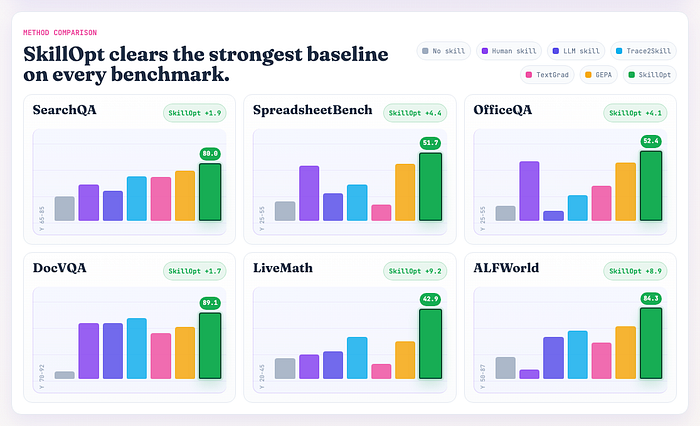
Figure 3: SkillOpt’s performance across six major benchmarks. Under the premise of not modifying the underlying model weights at all, the purely text-evolved skill documents comprehensively outperformed the strongest human-written skills and other baseline algorithms across various complex tasks (such as search, spreadsheets, mathematical reasoning, etc.).
Engineering Reality: Zero Inference Cost and Transferability
When we pull our gaze back from these elegant mechanisms to the reality of engineering deployment, SkillOpt’s most glaring advantage is that it achieves “zero inference cost”.
During the development and optimization phases, you indeed orchestrate models to derive textual gradients, reflect, and modify documents. But once the training converges, the final deliverable handed to the developer is simply a battle-tested, plain-text file. When deployed into a production environment, this skill.md merely needs to be fed into the foundational model as a System Prompt. There is absolutely no need to deploy massive, fine-tuned weight architectures.
Even more profoundly, this approach of distilling core business logic into plain text imbues these digital assets with incredible cross-generational transferability. Regardless of how rapidly underlying foundation models iterate in the future, these systematically polished skill.md files — refined via pure textual gradient optimization — can be directly reused, and they will likely unlock even greater efficacy when backed by stronger models.
SkillOpt’s emergence is not just an effective supplement to the existing Agent optimization paradigm; in the era of large models, it represents a crucial exploration into redefining the collaborative boundaries between humans and AI.
Reference:
SkillOpt: Executive Strategy for Self-Evolving Agent Skills (Microsoft Research)
Project Homepage:https://microsoft.github.io/SkillOpt/
Originally published on Medium.

 Blog
Blog 